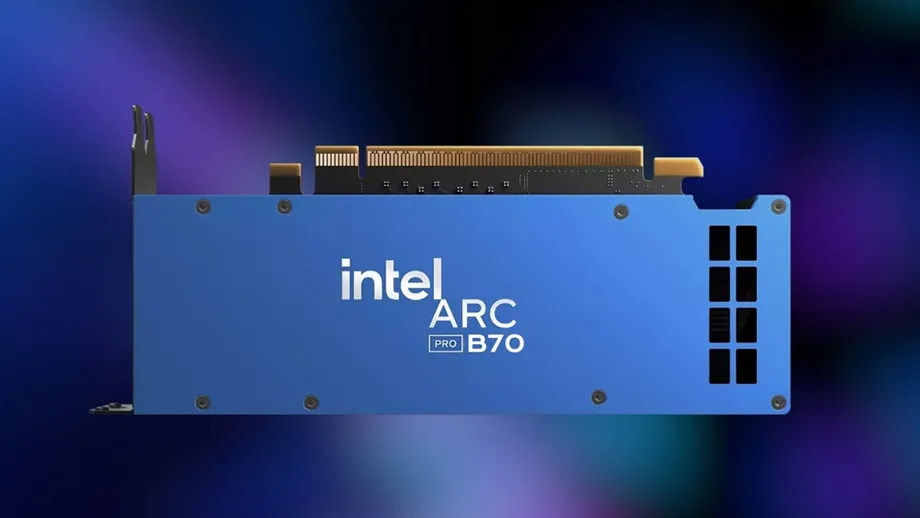
Intel Arc Pro B70 Review: 32GB of VRAM for Under $1,000 Is a Game-Changer for Local AI
If you’ve been watching the local AI space, you know the biggest frustration has always been VRAM. You want to run a 27B parameter model locally — great, now go spend $2,000+ on a GPU with enough memory to actually fit it. Intel just blew that wall open.
The Arc Pro B70 is Big Battlemage — the full-fat Xe2 GPU Intel has been sitting on — and they’ve shipped it first as a pro/AI card with 32GB of GDDR6 at $949. That’s not a typo. Thirty-two gigabytes. Under a thousand dollars. Let’s get into it.
Specs at a Glance
| Spec | Detail |
|---|---|
| Architecture | Xe2 (Battlemage) |
| Xe Cores | 32 |
| XMX AI Engines | 256 |
| AI Performance | 367 INT8 TOPS |
| FP32 Performance | 22.9 TFLOPS |
| VRAM | 32GB GDDR6 |
| Memory Bus | 256-bit |
| Memory Bandwidth | 608 GB/s |
| Boost Clock | 2.8 GHz |
| Price | $949 |
The Local AI Story — And It’s a Good One
This is what the Arc Pro B70 was built for, and it shows. Let’s break down what you can actually run.
VRAM Is the Whole Ballgame
At 32GB, the B70 lets you load models that simply don’t fit on anything else under $1,500. Here’s a practical breakdown:
- 7B models (FP16, ~14GB) — Load with ease and massive KV cache headroom. These run fast and smooth.
- 13B models (FP16, ~26GB) — Fit comfortably with a constrained-but-usable KV cache. Totally workable for daily use.
- 27B models at 4-bit (Qwen 3.5 27B, ~16GB) — This is the headline. You can run a 27B model quantized to 4-bit with room left for a real context buffer. On a single GPU. For under $1,000. That’s genuinely wild.
The context window story is equally strong. A single B70 can hold up to a 93,000-token context window before exhausting memory — 2.2x larger than the NVIDIA RTX PRO 4000. For long-document RAG pipelines, coding assistants, or extended agentic workflows, that headroom matters enormously.
Performance vs. NVIDIA RTX PRO 4000
Intel’s own numbers show the B70 delivering 85% higher token throughput against NVIDIA’s RTX PRO 4000 on Ministral Instruct 8B in BF16 — and at roughly half the price with 33% more VRAM. Independent benchmarks from Phoronix and CraftRigs back this up. The gap is real.
The 256 XMX engines push 367 INT8 TOPS of AI compute. Those engines support INT2, INT4, INT8, FP16, BF16, and TF32 — the full precision range you need for modern inference workloads. Whether you’re running quantized models through llama.cpp or full-precision weights via OpenVINO, the hardware has the right toolkit.
Software Ecosystem — Honest Take
This is where you need realistic expectations. Intel’s software stack has come a long way, but it’s not CUDA. PyTorch XPU support landed officially in 2025, and vLLM’s XPU kernels are still maturing. OpenVINO is the recommended inference path and it’s genuinely good — fast, model-compatible, and actively developed.
For the average local AI enthusiast running Ollama or llama.cpp, things mostly just work now. For production deployments or custom CUDA-ported kernels, you’ll hit friction. Intel’s OneAPI is a solid abstraction layer, but expect to spend some setup time if you’re coming from an NVIDIA workflow.
Bottom line: if OpenVINO covers your use case (it covers most), the software story is fine. If you need bleeding-edge CUDA kernels on day one, wait.
Gaming — Bonus Round
The Arc Pro B70 isn’t positioned as a gaming card, but the hardware is capable, and people will game on it. In testing across Monster Hunter Wilds, Shadow of the Tomb Raider, and Cyberpunk 2077: Phantom Liberty at 1080p and 1440p, the B70 put up results ~45% faster than the Arc Pro B60 in both average frame rates and 1% lows.
That’s a meaningful jump. It won’t challenge an RTX 5080 for pure rasterization, and the Pro driver stack isn’t tuned for gaming like GeForce drivers are — but if you want to run local models and occasionally game, the B70 won’t embarrass you. XeSS upscaling helps at 1440p, and ray tracing performance is decent for a card at this price.
Who Should Buy This?
Yes, buy it if you:
- Run local LLMs and have been hitting VRAM walls on 16–24GB GPUs
- Want to experiment with 27B+ models without breaking the bank
- Are building a multi-GPU inference rig (four B70s hit 369 tok/s on Qwen 3.5 27B)
- Are comfortable with OpenVINO or willing to spend time on setup
Hold off if you:
- Depend heavily on CUDA-specific libraries with no XPU port
- Need a pure gaming GPU — a consumer Arc B770 would serve you better when it arrives
- Are running a production inference cluster that requires stable, battle-tested tooling
Budget Pick
Not quite ready for the $949 ask? The Intel Arc Pro B65 (same Battlemage GPU, trimmed to 20 Xe cores) launched in mid-April 2026 with 32GB VRAM at a lower price point. You give up some raw compute but keep the memory capacity — still fits 27B models, still destroys the VRAM-per-dollar math.
Verdict
The Arc Pro B70 is the most disruptive GPU Intel has shipped for the local AI crowd. 32GB of GDDR6, 256 XMX engines, and a $949 starting price combine to break the VRAM ceiling that’s been frustrating home AI builders for years. The software ecosystem isn’t CUDA, but it’s good enough for most inference use cases today and improving fast.
If you’ve been waiting for an affordable way to run 27B models locally without compromise — the wait is over.
Score: 8.8 / 10
Check Price on Amazon →