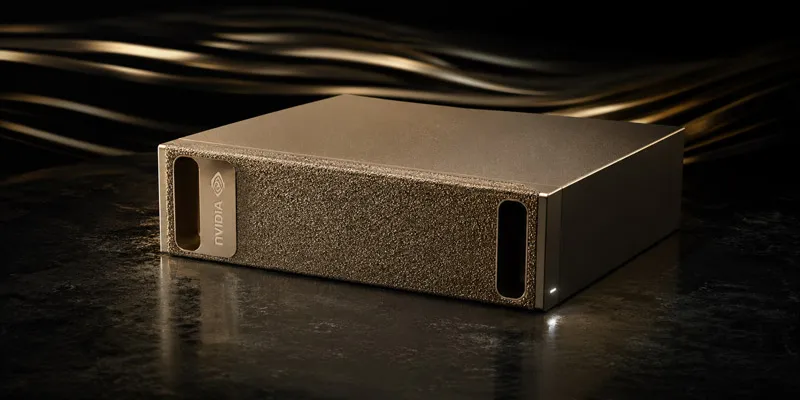
NVIDIA DGX Spark Review: A Personal AI Supercomputer That Actually Delivers
The promise of running truly massive AI models locally — not 7B quantized toy models, but real 70B and 120B parameter beasts — has been a moving goalpost for years. The NVIDIA DGX Spark, powered by the GB10 Grace Blackwell Superchip, plants the flag and says: we’re here. At $4,699 it isn’t cheap, but nothing else on a desktop lets you run a 120B parameter model at full precision without breaking a sweat. This is the machine that makes local AI real for developers, researchers, and builders who refuse to live inside a cloud bill.
Check Price on Amazon →Specs at a Glance
| Spec | Detail |
|---|---|
| Chip | NVIDIA GB10 Grace Blackwell Superchip |
| AI Performance | 1 PetaFLOP (sparse FP4) / ~500 TFLOPS (dense FP4) |
| CPU Cores | 20 ARM cores — 10× Cortex-X925 @ 4GHz + 10× Cortex-A725 @ 2.8GHz |
| Memory | 128 GB LPDDR5x unified (CPU + GPU shared) |
| Memory Bandwidth | 273 GB/s |
| Max Model Size | Up to ~200B parameters locally |
| Interconnect | NVLink-C2C (CPU↔GPU) |
| OS | Ubuntu (NVIDIA DGX OS) |
| Price | $4,699 |
The Local AI Story — Why This Machine Matters
Here’s the uncomfortable truth about running large language models locally before the DGX Spark: you were always compromising. A 24GB GPU (RTX 4090) handles 7B or maybe 13B models comfortably. Push to 70B and you’re either quantizing down to near-uselessness or shelling out for a multi-GPU rig that costs $10,000+. The DGX Spark obliterates that ceiling.
128 GB Unified Memory — The Real Headline
The GB10 Superchip uses NVIDIA’s NVLink-C2C interconnect to fuse the CPU and GPU into a single chip with one flat 128 GB memory pool. There’s no discrete VRAM. Everything the CPU and GPU touch lives in the same 128 GB of LPDDR5x. That means a 120B parameter model at MXFP4 precision fits entirely in memory — no offloading, no model splitting, no drama.
This is genuinely revolutionary for a desktop device. To put it in perspective: an H100 80GB PCIe card gives you 80 GB of isolated GPU memory and costs over $30,000. The DGX Spark gives you 128 GB of unified access memory for $4,699. The trade-off is bandwidth — 273 GB/s versus the H100’s 3.35 TB/s — but for inference workloads on models you’re actually prototyping and testing, the Spark’s bandwidth is more than sufficient.
Real Benchmark Numbers
NVIDIA’s January 2026 TensorRT-LLM and speculative decoding updates delivered up to 2.5× performance improvements over launch numbers. Here’s where things stand today:
- Llama 3.1 8B (batch-32): 368 tokens/sec — screaming fast, genuinely faster than you can read
- GPT-class 120B (MXFP4), prompt processing: 1,723 tokens/sec — feeding context at serious speed
- GPT-class 120B (MXFP4), generation: ~39 tokens/sec — comfortably usable for interactive sessions
- LoRA fine-tuning Llama 3.1 8B: peak 53,657 tokens/sec training throughput
That 39 tokens/sec on a 120B model is the number that matters. It’s not blazing, but it’s conversational. You’re not staring at a spinning cursor — you’re getting responses in real time from a model that would cost you $5,000+/month to run at scale in the cloud.
With NVIDIA’s speculative decoding (EAGLE3) enabled, throughput on smaller models jumps even further — up to 2× over standard decoding. The software story here is strong and improving.
Models You Can Run Right Now
The DGX Spark handles essentially everything in the open-source ecosystem:
- Llama 3.x 8B / 13B / 70B — all run excellently, 70B at full BF16 fits comfortably
- Mistral / Mixtral — including the 8×22B MoE variants
- DeepSeek R1 / Coder — the 67B and 70B versions run without quantization compromise
- Qwen 2.5 72B — loaded and running in minutes
- GPT-NeoX / Falcon 180B — at MXFP4, pushes the ceiling but works
NVIDIA’s NIM container ecosystem means spinning up an optimized inference server takes minutes, not hours of environment wrestling. This is where being in the CUDA ecosystem pays dividends — every optimization NVIDIA ships for the data center trickles down here.
Fine-Tuning and Training — Bonus Superpower
Most local AI boxes are inference-only. The DGX Spark is not. The GB10 Blackwell GPU supports LoRA and QLoRA fine-tuning on models up to the memory limit. That 53,657 tokens/sec LoRA training number on Llama 3.1 8B is serious — you can meaningfully fine-tune a custom model in hours, not days. For developers building domain-specific assistants or coding agents trained on their own codebase, this is a big deal.
Build Quality and Design
NVIDIA didn’t build a gamer box. The DGX Spark is compact, matte-black, and purely utilitarian — it could pass for a high-end NAS or network appliance. It runs cool and quiet under typical inference loads. The ARM-based architecture means fanless operation at idle is possible depending on thermal configuration.
The downside of the ARM platform: some x86-specific tools and Docker images don’t run natively. You’ll occasionally need ARM-compatible builds of dependencies. This is a shrinking problem in 2026 as the ecosystem has largely caught up, but it’s worth noting if you’re evaluating it against an x86 workstation.
Who Should Buy the DGX Spark?
Yes, buy it if you are:
- An AI developer or ML engineer who wants to prototype 70B+ models without cloud costs
- A researcher running experiments that require full-precision inference on large models
- A startup or indie builder building AI-native products and needing a local inference server
- Someone paying $1,500+/month in GPU cloud bills — the DGX Spark can pay for itself in under 4 months
Hold off if you are:
- A gamer or content creator — this is not a gaming GPU and has no display outputs
- Someone whose workloads fit comfortably in 24 GB VRAM — an RTX 4090 is a better value
- Expecting raw throughput at scale — a cloud H100 still smokes it on token throughput for production APIs
- On a tight budget — there are better-value alternatives for running sub-30B models
Budget Pick: Beelink GTR9 AI Max+ 395
If $4,699 is a stretch, the Beelink GTR9 AI Max+ 395 hits different. It runs AMD’s Ryzen AI Max+ 395 (Strix Halo) APU with up to 128 GB of LPDDR5x unified memory — the same memory architecture concept as the DGX Spark — starting around $1,100–$1,500 depending on configuration.
You won’t match the DGX Spark’s Blackwell GPU compute or its petaFLOP rating, but for running 70B models at Q4/Q8 quantization and experimenting with local AI agents, it punches well above its price point. Tom’s Hardware confirmed the DGX Spark beats it on raw throughput, but if your use case is 7B–30B models and you don’t need fine-tuning, the Beelink saves you $3,000+.
→ Check out our Strix Halo mini PC coverage
Verdict
The NVIDIA DGX Spark is the best local AI development machine money can buy in 2026. It’s the first desktop device that genuinely lets you say “I run 100B parameter models locally” without asterisks. The 128 GB unified memory pool, petaFLOP-class Blackwell AI compute, and NVIDIA’s maturing software stack (TensorRT-LLM, NIM containers, speculative decoding) combine into something that feels like the future of AI development arrived early.
The price is real, the ARM platform has occasional friction, and it’s not for everyone. But for AI developers, ML researchers, and serious builders? The DGX Spark is the machine you’ve been waiting for.
Score: 9.2 / 10
Check Price on Amazon →