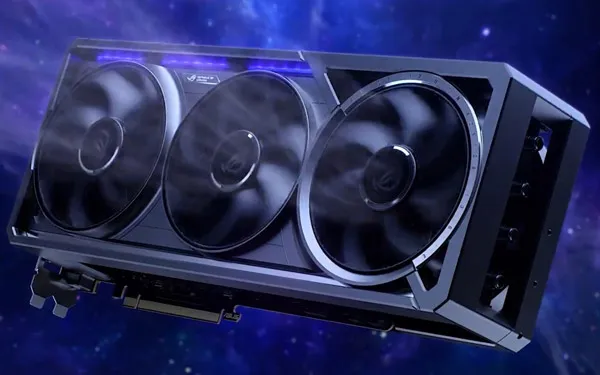
ASUS ROG Astral GeForce RTX 5090 OC Edition Review
Let’s get one thing out of the way: the RTX 5090 is the fastest consumer GPU ever built. That’s not a marketing claim — it’s just true. And the ASUS ROG Astral OC Edition wraps NVIDIA’s Blackwell flagship in one of the most impressive custom cooler designs to date. Quad fans, a patented vapor chamber, and a phase-change GPU thermal pad keep a card that can draw over 600W from ever breaking a sweat.
The question isn’t whether the ROG Astral RTX 5090 OC is good. It’s whether the premium over Founders Edition is worth it — and whether you can actually find one near MSRP.
Specs at a Glance
| Spec | Detail |
|---|---|
| GPU | NVIDIA Blackwell GB202 |
| CUDA Cores | 21,760 |
| Boost Clock (OC) | 2,610 MHz |
| VRAM | 32GB GDDR7 |
| Memory Bus | 512-bit |
| Memory Bandwidth | 1,792 GB/s |
| TDP | ~600W |
| Cooler | Quad Axial-Tech fans + vapor chamber |
| Slot Width | 3.8 slots |
| MSRP | $1,999 (Founders Edition) |
| Street Price (Astral) | ~$4,329 |
Gaming Performance — Simply Unbeatable
The ROG Astral OC’s 2,610 MHz boost is 8.4% above reference clock, and it shows. At 4K, games like Cyberpunk 2077 and Alan Wake 2 that previously demanded DLSS 3 to stay above 60fps now run at 90+ fps natively. With DLSS 4 Multi Frame Generation enabled, you’re looking at 120–144fps at 4K max settings in virtually every current title.
The 1,792 GB/s memory bandwidth is the real headline. It’s not just about raw frame rates — the bandwidth transforms texture streaming, ray tracing quality, and load times in ways that other specs don’t capture. At 1440p, the RTX 5090 is almost comically overpowered, but if you’re gaming at 4K on a high-refresh panel or eyeing 8K, this is the card that finally makes those resolutions genuinely viable.
Ray tracing performance is generationally ahead of the RTX 4090. Path-traced rendering in Cyberpunk 2077 runs over 50% faster than the previous generation with DLSS 4 off. That’s not incremental — that’s a step change.
Local AI Performance — The Unexpected Star
The 32GB of GDDR7 at 1,792 GB/s makes the RTX 5090 the best single-card LLM inference machine available, period. A few practical benchmarks:
- 7B models (FP16): Blazing fast — 180+ tok/s in llama.cpp, GPU barely breaks a sweat
- 13B models (FP16): Runs with enormous KV cache headroom
- 70B models (Q4_K_M): Fits on a single card. First time this has been possible under $10,000
- SDXL / Flux image generation: Batch inference is roughly 2–3x faster than RTX 4090
The bandwidth advantage over previous-gen cards is most visible in autoregressive inference, where the bottleneck is almost always memory bandwidth rather than compute. The 5090’s GDDR7 pipeline makes 13B and 30B models feel snappy in ways that 24GB GDDR6 cards simply can’t match.
For anyone building a serious local AI workstation, the RTX 5090 is the card to buy. CUDA support is obviously first-class, and frameworks like vLLM, llama.cpp, Unsloth, and Ollama all run without any setup friction.
Cooling and Thermals
ASUS’s quad Axial-Tech fan array combined with a patented vapor chamber is doing serious work here. Under full gaming load, the GPU core tops out around 72°C — impressive for a 600W card. Noise levels are lower than many dual-fan designs at the same thermal target. The phase-change GPU thermal pad is a thoughtful addition that maintains contact pressure over time.
The 3.8-slot footprint is a genuine consideration. You’ll need a full-tower case with aggressive GPU clearance, and the second PCIe slot is almost certainly toast. Plan accordingly.
Who Should Buy This?
Yes, buy it if you:
- Game at 4K on a 144Hz+ display and want the highest fidelity possible
- Run local LLMs and want to reach 70B models on a single card
- Build AI-assisted creative workflows (image gen, video, multi-modal)
- Are comfortable paying a premium for ASUS’s build quality and cooler
Hold off if you:
- Can’t find it near MSRP — at $4,300+ the value equation weakens significantly
- Game at 1080p or 1440p — the RTX 5080 delivers 85% of the performance at 60% of the price
- Don’t have a PSU with 850W+ headroom and a full-tower case
Budget Pick — ASUS TUF Gaming RTX 5080 OC
Not ready to drop $2,000+? The ASUS TUF Gaming RTX 5080 OC sits at around $1,099 and delivers remarkable performance for 4K gaming and local AI up to 30B models. It uses NVIDIA’s GB203 die with 16GB GDDR7 — still a step up from last gen in every dimension that matters. The TUF cooler is excellent and significantly quieter than the Astral under load.
Check TUF RTX 5080 Price on Amazon →Verdict
The ASUS ROG Astral GeForce RTX 5090 OC Edition is the best GPU ever made for gaming, local AI, and creative workloads. The 1,792 GB/s bandwidth and 32GB GDDR7 represent a genuine generational leap — not just a spec bump. ASUS’s cooling solution is exemplary, and the factory overclock is stable and meaningful.
The only thing standing between this card and a perfect score is the price reality. MSRP of $1,999 is already a big ask; the $4,300+ street prices that have been the norm make it a harder recommendation for most people. If you can find one near MSRP — buy it without hesitation.
Score: 9.3 / 10 — Editor’s Choice
Check Price on Amazon →