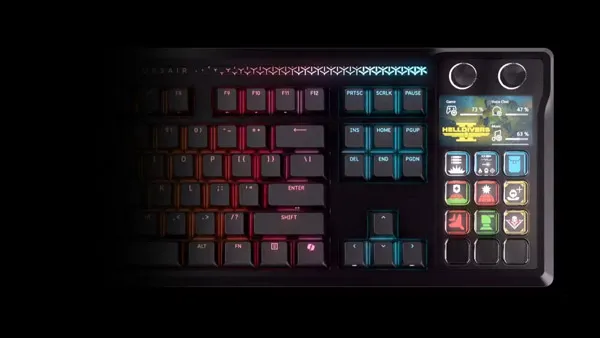
Corsair Galleon 100 SD Review: The Gaming Keyboard That Ate Your Stream Deck
For years, streamers and competitive gamers have had the same two boxes on their desks — a high-end mechanical keyboard and an Elgato Stream Deck sitting awkwardly to the side. Corsair just welded them together, and the result is the Galleon 100 SD: a 95% mechanical keyboard with a full Stream Deck module where the numpad used to be. It’s the kind of “why didn’t anyone do this sooner” product that either makes you immediately want one or raises the very reasonable question: do I even use macros?
Specs at a Glance
| Spec | Detail |
|---|---|
| Layout | 95% (Stream Deck replaces numpad) |
| Switches | CORSAIR MLX Pulse (linear, pre-lubed, hot-swap) |
| Actuation | 45g / 2.0mm actuation / 3.6mm total travel |
| Polling Rate | 8,000Hz |
| Stream Deck Module | 12 LCD keys (3×4), 2 programmable dials, 720×180 color screen |
| Anti-Ghosting | FlashTap SOCD |
| Keycaps | PBT double-shot |
| Connection | USB-A wired |
| Dimensions | 448 × 159 × 42 mm |
| Price | $349.99 |
The Keyboard Side: Legitimately Excellent
Let’s address the core product first — because if the keyboard was mediocre, nothing else would matter. It isn’t. The MLX Pulse linear switches are pre-lubed from the factory and feel genuinely smooth and thocky right out of the box, without the usual lottery of “did these need to be lubed or not.” Actuation is a comfortable 45g at 2.0mm — firm enough to avoid accidental keystrokes in tense firefights, light enough not to tire your fingers during marathon sessions.
The 8,000Hz polling rate is the headline competitive spec, and in fast-paced titles like Valorant or CS2, you’ll feel the difference vs. a standard 1,000Hz board — input lag is essentially imperceptible. FlashTap SOCD (Simultaneous Opposing Cardinal Directions) is a genuine advantage in movement-heavy shooters, letting you rapidly tap opposing keys with behavior that mirrors a controller’s analog snap. Corsair also made the switches hot-swappable, so you’re not locked into Pulse linears forever — that’s a premium detail that earns real respect at this price.
The PBT double-shot keycaps are a small but meaningful win. Most keyboards at $250–300 still ship with thin ABS caps that shine and wear within months. Corsair included quality caps here, and combined with the north-facing RGB (reduces keycap legends appearing dim), the lighting looks sharp.
The Stream Deck Module: Where It Gets Wild
The right side of the Galleon 100 SD replaces the traditional numpad with a genuine Elgato Stream Deck integration — 12 full-color LCD keys arranged in a 3×4 grid, two programmable rotary dials, and a 720×180 color strip display showing live info (time, Twitch viewer count, CPU/GPU stats, active scene, whatever you configure). This isn’t a neutered clone of the Stream Deck — it’s running the same software, accessing the same plugin marketplace, and behaving identically to a standalone Stream Deck MK.2.
For streamers, this is enormous. Scene switching, alert triggering, clip saving, muting audio sources — all accessible from the same device your fingers are already on. For non-streamers, it’s still useful: one-click Discord mute, launching apps, activating Windows shortcuts, triggering Spotify controls. The two dials add a satisfying tactile layer — one dial typically controls system volume, the other can be bound to anything (timeline scrubbing, brush size in Photoshop, sensitivity toggling in-game).
The strip display showing live stats is genuinely cool during gaming sessions. Seeing GPU temp or FPS count without tabbing out or glancing at a second monitor feels like a small luxury that quickly becomes essential.
The Software Caveat
Here’s where it gets real: iCUE and Stream Deck software need to cooperate, and they don’t always do so gracefully. In testing across multiple setups, some users report intermittent connection drops between the integrated Stream Deck module and the iCUE software layer — primarily when using web-based integrations. In roughly 20 connection attempts across browsers, connectivity succeeded only about 4 times in one reviewer’s hands. Corsair has pushed firmware updates, and day-to-day stability is solid for most users, but if you rely on browser-sourced Stream Deck integrations heavily, expect occasional frustration until the software matures.
Gaming Performance: Does the Layout Cost You Anything?
Swapping the numpad for a Stream Deck module shrinks the overall width, but the Galleon 100 SD is actually deeper than a standard TKL at 159mm — the Stream Deck module adds front-to-back chassis depth. Most gamers will barely notice the added depth; mouse positioning relative to the keyboard is unchanged since the right edge stays the same. If your desk is already fighting for space, measure before you buy.
The lack of wireless is the bigger limitation. In 2026, a $350 flagship keyboard shipping wired-only feels like a deliberate holdback — presumably because USB power stability matters for the Stream Deck module. It’s understandable, but competitors are offering 8,000Hz over 2.4GHz now. For desk-bound setups it’s a non-issue; for anyone who values cable-free living, it’s a genuine strike.
Who Should Buy This?
Buy it if:
- You stream or content-create and already own (or want) a Stream Deck
- You’re a competitive PC gamer who wants the best polling rate and SOCD support
- Desk real estate is limited and you want to consolidate devices
- You’ll actually use macro keys, shortcuts, or live info displays
Hold off if:
- You only need a keyboard — there are better value picks at $150–$200
- You prefer wireless peripherals
- You rely heavily on browser-based Stream Deck integrations (software stability concerns)
- You’re a numpad power user (spreadsheets, CAD, finance work)
Budget Pick: Corsair K70 RGB Pro + Elgato Stream Deck Mini
If $349 is too steep, the combination of a Corsair K70 RGB Pro ($109) and an Elgato Stream Deck Mini ($79) gets you to a similar experience for around $188 — saving you over $160. You’ll lose the SOCD support, the 8,000Hz polling, and the elegant single-device integration, but the core workflow (great mechanical keyboard + Stream Deck macros) is essentially replicated. It also occupies two USB ports instead of one, and takes up more desk space, but for most users the price gap makes it the smarter call.
Verdict
The Corsair Galleon 100 SD is the best execution of an idea the industry has needed for years. It doesn’t feel like a gimmick — it feels like the natural end state of two products that were always meant to be one. The keyboard is excellent on its own merits: fast, smooth, competitive-grade. The Stream Deck integration is full-featured and genuinely useful, not a cut-down afterthought. The main stumbling blocks — wired-only, occasional software hiccups, the price — are real but not disqualifying for the right buyer.
Score: 8.3 / 10
Check Price on Amazon →