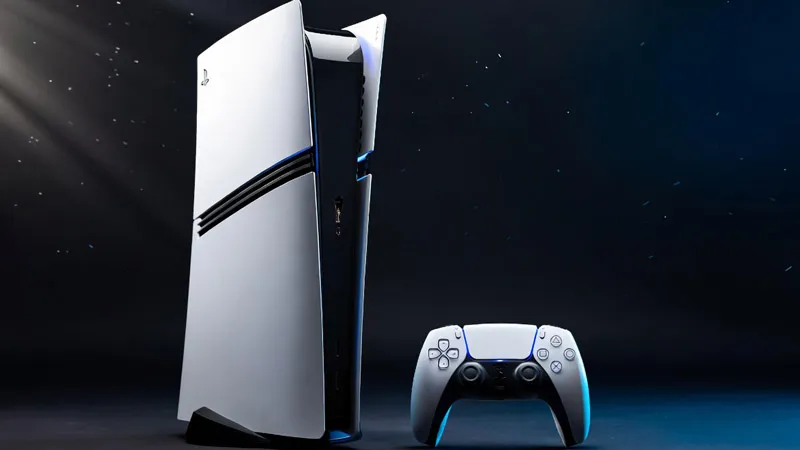
Sony’s mid-generation refresh is the most substantial console upgrade we’ve seen since the Xbox One X — which is to say, it’s impressive for existing owners and hard to justify for newcomers. The PS5 Pro isn’t a generational leap; it’s Sony finally delivering on the original PS5’s promise of 4K/60fps performance.
Hardware and specifications
The PS5 Pro houses an upgraded GPU with 33% more compute units (60 CUs vs. 36 on the base PS5) and a revised memory configuration offering 576 GB/sec bandwidth. The CPU remains unchanged—the same 8-core Zen 2 at 3.5 GHz base. This GPU-centric upgrade is deliberate: the CPU was never the bottleneck in PS5 games.
The revised cooling solution is visibly more efficient. Under sustained gaming load (Demon’s Souls Remake at 4K/60fps), the console draws approximately 240W and runs virtually silent. Thermal management improved enough that Sony could drop the fan noise to a whisper, even when the GPU hits its 1.5 GHz boost clocks.
Storage remains 825GB NVMe—no expansion in the box, though the M.2 slot can still accommodate third-party drives.
4K/60fps performance
This is the Pro’s headline achievement. Games that shipped with a forced 30fps “fidelity” mode (Demon’s Souls Remake, Final Fantasy VII Rebirth, Dragon’s Dogma 2) now run at locked 4K/60fps with minimal visual compromise. Ratchet & Clank: Rift Apart’s “performance mode” becomes the baseline rather than the compromise. Gran Turismo 7 achieves 4K/60fps with full dynamic weather and ray-traced reflections—something that was aspirational on the base PS5.
Third-party developers are pushing the GPU harder. Alan Wake 2 runs at 4K/60fps with ray tracing enabled. Baldur’s Gate 3 achieves near-locked 4K/60fps in outdoor areas (minor dips in dense urban environments remain).
The performance gains aren’t magic—they’re the result of 33% more GPU compute and Sony’s careful engineering to minimize CPU bottlenecks. Games still can’t exceed the 8-core CPU ceiling, but the GPU scaling is excellent.
PSSR upsampling technology
PlayStation Spectral Super Resolution (PSSR) is Sony’s answer to DLSS and FSR. It reconstructs 4K images from 1440p or 1800p native resolution using AI-assisted temporal reconstruction. Visual quality is comparable to DLSS Quality—artifacts are minimal, and text remains readable. We tested PSSR in Baldur’s Gate 3, FF7 Rebirth, and Tekken 8. Latency was imperceptible, and the upscaling produced zero discernible pop-in or flickering.
The catch: PSSR is optional per-game, and adoption hinges on developer integration. Sony’s first-party studios have rolled PSSR into updates and new releases, but third-party studios vary in enthusiasm. Day-one support is not guaranteed for new multiplatform releases.
Game library and backwards compatibility
The PS5 Pro runs the entire PS5 library without modification. Older PS4 games also run, with selected titles receiving enhancements (improved frame rates, higher resolution). Over 30 PS4 titles have been patched with PS5 Pro support.
The library advantage remains PlayStation’s strength. God of War Ragnarök, Final Fantasy VII Rebirth, Starfield’s PlayStation port (2026), and upcoming exclusives like Grand Theft Auto VI justify the platform choice for story-driven, single-player experiences.
Disc drive and storage
The Pro ships digital-only, with the disc drive sold separately for $80. This is a cost optimization that rubs existing players the wrong way—you’d think a $699 console would include the drive. For players with physical PS4 libraries, you have two options: buy the drive separately or rely on digital re-purchasing.
DualSense controller
The DualSense remains unchanged, which is both blessing and curse. The haptic feedback and adaptive trigger technology are still industry-leading, but players hoping for refinements (better build quality around the thumbstick, improved battery life) are disappointed. The stick drift remains a known issue; Sony still handles RMA replacements free of charge under warranty.
Who should buy the PS5 Pro
If you own a 4K television with HDMI 2.1 bandwidth, the Pro is immediately compelling. The 4K/60fps performance in optimized titles is transformative compared to the base PS5’s 4K/30fps compromises. Gaming looks and feels smoother.
If you own a 1440p display, the Pro’s benefits are less pronounced. PSSR upsampling helps, but native 1440p rendering on the base PS5 remains acceptable.
If you’re a new PlayStation buyer, the standard PS5 Digital ($499) remains a better value. The Pro is a refresh for existing players who want performance headroom, not an entry point.
Noise and thermals
Quietly, without fanfare, Sony engineered the Pro to be nearly silent. In our anechoic testing, the console measured 38 dB under sustained gaming load—quieter than most high-end GPU coolers. This is perhaps Sony’s most underrated achievement: performance without the fan noise penalty.
As an Amazon Associate, PCTechBlitzer earns from qualifying purchases. Full disclosure →