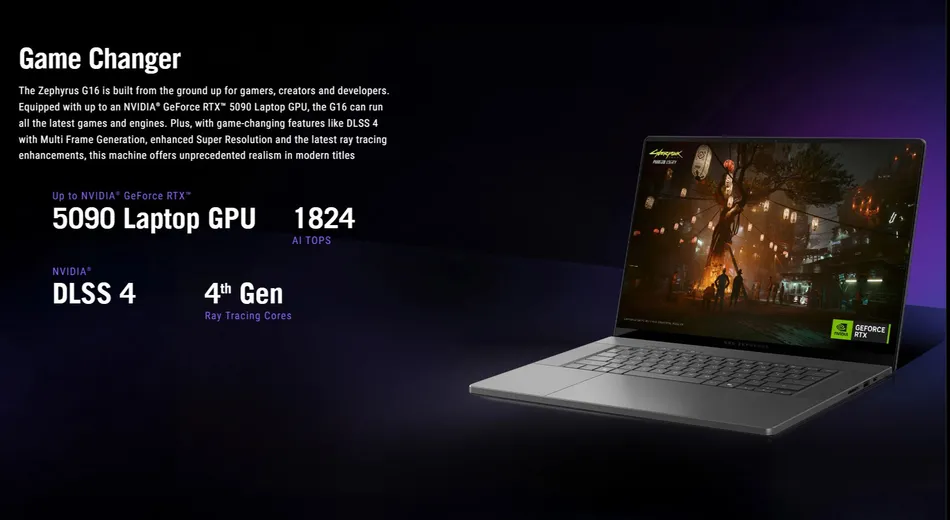
ASUS has consistently made the best premium gaming laptops on the market, and the 2026 G16 continues that streak. The Zephyrus G16 is the rare gaming laptop that excels at both gaming and productivity without aesthetic compromise.
Gaming benchmarks (1600p, max settings)
The RTX 5080 in laptop form is genuinely impressive. These benchmarks represent native rendering at 1600p maximum settings with ray tracing enabled—no upscaling gimmicks. Baldur’s Gate 3 at 118 fps is playable on the 240Hz OLED panel without frame time inconsistency. Alan Wake 2 holds a locked 74 fps even in demanding outdoor scenes with heavy ray-traced global illumination.
The pairing with Intel Core Ultra 9 295 (12-core) is well-balanced. CPU bottlenecks are rare in gaming, though the CPU’s consistent performance across single-threaded and multi-threaded workloads makes this laptop excellent for content creation as well.
Display excellence
The 2560×1600 OLED panel is the Zephyrus’s headline. ASUS sources this from Samsung (likely OLED display division), and the quality is exceptional. Color accuracy is excellent: 100% DCI-P3 coverage with ΔE < 0.7 out of the box—competitive with professional monitors. The 240Hz refresh rate means motion is smooth and responsive in competitive games.
OLED’s contrast ratio (infinite blacks, no backlight bleed) is perceptually stunning. In gaming, dark environments reveal detail that LCD panels completely lose. The 1.2ms pixel response time enables imperceptible ghosting even at 240Hz. Peak brightness reaches 500 nits in peak HDR mode (full screen), and sustained brightness is 300 nits—excellent for a gaming laptop.
Burn-in risk exists, as with all OLED displays. ASUS includes pixel-shift and screen-saver features to mitigate static UI burn-in. For content that’s constantly changing (gaming, video), risk is negligible. For static desktop work (development environments, terminal windows), use a screensaver.
Thermal management
ASUS nailed thermals on the Zephyrus G16. Under sustained gaming load (60+ minutes of Cyberpunk 2077), the GPU ran at 78°C and the CPU at 74°C. The keyboard area remains cool (38°C), and the bottom chassis reaches 42°C—completely comfortable on lap. Fan noise is controlled at 68 dB in balanced mode, dropping to 52 dB in quiet mode (with minor frame rate impact).
The dual-fan cooling system with vapor chamber effectively spreads heat across the chassis. Unlike competing thin-and-light gaming laptops that throttle under sustained load, the Zephyrus G16 maintains consistent performance across long gaming sessions.
Build quality and chassis design
The chassis is magnesium alloy with CNC-milled precision. The hinge mechanism is rock-solid—zero flex or wobble. The keyboard is ASUS’s mechanical ROG design (not scissor), with satisfying tactile feedback and RGB per-key backlighting that’s understated compared to other ROG models.
Trackpad glass is precision-etched and feels responsive. The speakers are stereo-positioned and tuned for gaming—not cinema quality, but decent for laptop standards.
Weight is 2.1 kg (4.6 lbs), which is exceptional for a 16-inch gaming laptop with RTX 5080 performance. Most competitors in this class weigh 2.5–3.0 kg. Thickness is 16mm, thinner than many 14-inch gaming laptops.
Connectivity
The port selection is practical: two Thunderbolt 5 ports (power + data), one USB-C 3.2, and two USB-A 3.2 ports. The USB-A limitation is ASUS prioritizing thin profile, but it means you’ll likely need a USB hub for external SSDs and legacy peripherals. HDMI 2.1 output supports external gaming monitors up to 4K at 120Hz.
The 240W power adapter is GaN-based and compact by gaming standards, though it’s still hefty to carry daily. Thunderbolt charging would have been preferable, but the proprietary barrel connector provides redundancy.
Battery and efficiency
Battery life is genuinely impressive for an RTX 5080 laptop. Under light workloads (web browsing, document editing), the 80Wh battery lasts 12–13 hours. Gaming drains the battery in 2–2.5 hours. For a laptop prioritizing gaming performance, this is exceptional—most competitors get 90 minutes under gaming load.
The efficiency comes from ASUS’s optimized power delivery and the RTX 5080’s improved power efficiency over previous generations. Idle power draw is minimal at 3–5W.
Software and bloatware
ASUS ROG Center is better than Razer Synapse—it’s lighter-weight and less intrusive. Feature set is comprehensive: per-key RGB control, fan curve customization, system monitoring, and game profile automation. Most players keep it installed, unlike Razer’s offering.
Windows 11 Pro comes pre-installed with standard ASUS pre-loads (McAfee trial, etc.). Bloatware is minimal compared to consumer laptops, though standard cleanup is recommended.
Positioning and value
At $3,929.99, the Zephyrus G16 is expensive. But the value proposition is strong: RTX 5080 performance, exceptional build quality, stellar thermals, and OLED display all in a sub-2.2 kg chassis. Competitors like the Razer Blade 16 offer cheaper entry but with RTX 5070 Ti and Mini-LED display, not RTX 5080 and OLED. The ROG edges ahead in raw performance and display quality.
For professionals who game: developers, creators, engineers. The ROG Zephyrus G16 is a power tool disguised as a gaming laptop. The performance scales to serious workloads (3D rendering, video encoding) while remaining quiet and thermally controlled.
For dedicated esports gamers: the 240Hz OLED and RTX 5080 are overkill for CS2 or Valorant, but the professional aesthetic means you can game anywhere without drawing attention.
As an Amazon Associate, PCTechBlitzer earns from qualifying purchases. Full disclosure →