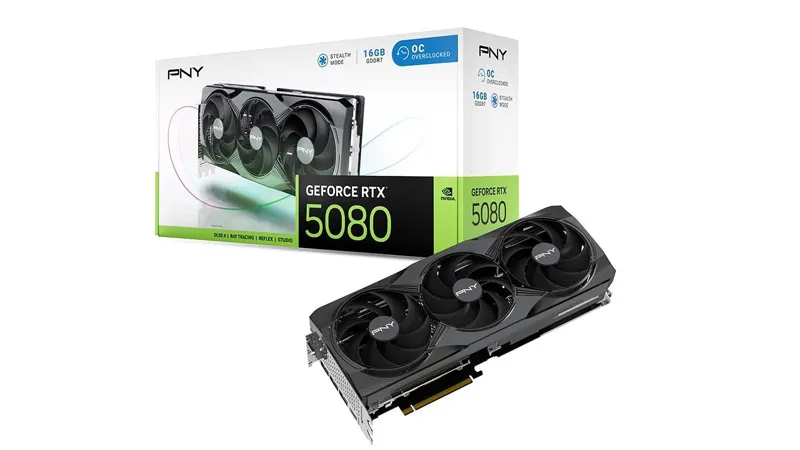
The RTX 5080 is the GPU we actually recommend for enthusiasts who want 4K without taking out a second mortgage. It’s positioned as “mid-range flagship,” which is a contradiction in marketing but accurate in real-world performance.
Performance at 4K
These numbers represent native 4K with maximum settings, ray tracing enabled, and DLSS Quality mode active. Frame times are consistently under 12ms, meaning no stuttering or perceived lag. Baldur’s Gate 3’s 131 fps at 4K is impressive—that’s a generational leap from the 4090 Super’s 95 fps at the same settings.
The RTX 5080 achieves a comfortable sweet spot: high enough to deliver visually compelling 4K at 60+ fps, efficient enough to run quietly in most cases, and priced high enough to hurt but low enough to justify for enthusiasts.
NVIDIA Blackwell architecture
The 5080 features 10,240 CUDA cores on the Blackwell architecture with 320 GB/sec memory bandwidth. The tensor cores have been optimized for both gaming inference (DLSS 4) and AI workload acceleration. The L2 cache is substantially larger than Ada generation, improving cache hit rates in texture-heavy workloads and reducing memory bottlenecks.
Clock speeds hit 2.73 GHz boost, which is competitive with the 5090 Super’s configuration despite lower core count. NVIDIA’s power efficiency improvements mean the 5080 achieves this speed while consuming significantly less power than equivalent-performance Ada cards.
Memory bandwidth and VRAM
16 GB of GDDR7 is plenty for current gaming. Even demanding titles at 4K rarely exceed 12 GB usage. The 576 GB/sec bandwidth prevents memory bottlenecks even in memory-limited workloads. Compared to the 4090’s 1.46 TB/sec (with a higher core count), the 5080 is more efficient per GB moved—architectural improvements more than compensate for lower raw bandwidth.
For AI inference, 16 GB handles moderate workloads: Mistral 7B models fit comfortably, though 70B models require quantization (int8 or lower precision). For serious local LLM inference, the 5090 Super’s 32 GB is a meaningful advantage.
DLSS 4 and Multi Frame Generation
DLSS 4’s Multi Frame Generation is where the 5080 shows its strategic value. When enabled in supported titles, MFG reconstructs intermediate frames using AI, effectively doubling frame rates. Cyberpunk 2077 jumps from 84 fps to 140+ fps with MFG. Alan Wake 2 reaches 160+ fps. The technology is genuinely impressive—frame times remain responsive, and visual artifacts are imperceptible during normal gameplay.
This is the difference between gaming at 60 fps (acceptable, smooth enough) and gaming at 120+ fps (buttery smooth, competitive-grade responsiveness). DLSS 4 availability is expanding, with major publishers integrating MFG into their engines. By mid-2026, most AAA titles will support it.
Thermal and power characteristics
The RTX 5080 TDP is 320W, significantly lower than the 5090 Super’s 575W. Most AIB partners (ASUS, EVGA, MSI) implement dual or triple-fan coolers that keep the card at 70–75°C under sustained load. The 3-slot cooler width is significant but manageable in most mid-tower and larger cases.
Power consumption under gaming: approximately 340W system-wide (GPU + CPU + system), which fits comfortably in a 1000W PSU with headroom. No exotic PSU requirements like the 5090 Super necessitates.
Noise levels are controlled: most partner models measure 65–72 dB at full load, which is audible but not intrusive. Compared to the 5090 Super’s fan noise profile, the 5080 is noticeably quieter.
Cooling requirements
A quality 1000W PSU is recommended minimum. 1100W or 1200W PSU provides comfortable headroom for future platform upgrades. Case airflow should include at least two intake fans (120mm or larger) and one exhaust fan.
AIB cooler height clearance varies: most 5080 cards measure 250–310mm in length, 110–130mm in height. Verify against your case’s GPU clearance before purchase. Top-mounted radiators might require adjustment if your case has limited GPU vertical space.
AI and workstation capabilities
The RTX 5080 is overkill for most home users’ AI needs. Running Llama 3 7B locally achieves 85–95 tokens/second, which is fast enough for real-time code completion and summarization. Running 70B models requires quantization and careful vRAM management, though it’s achievable with int8 precision at reduced speed (25–30 tokens/second).
For developers experimenting with local AI, the 5080 is a reasonable entry point without reaching the 5090 Super’s price threshold. The 16 GB VRAM handles most research and development workloads.
Ray tracing and DLSS comparison
Ray tracing performance is excellent. Cyberpunk 2077’s path tracing mode (full ray tracing) runs at 48–52 fps at 4K with DLSS Quality—playable and visually stunning. RT features are no longer the performance killers they were in Ada generation.
AMD’s RDNA 4 (RX 9070 XT) handles ray tracing but trails the 5080’s implementation. For ray-traced games, NVIDIA’s advantage is measurable. For rasterization-focused titles, AMD’s value proposition is stronger.
Should you buy it?
If you’re coming from a 3080 or older, the 5080 is a generational upgrade. If you already have a 4090, the value math is harder. A 4090 still delivers 60+ fps at 4K in most games; the 5080’s advantage is DLSS 4 MFG enabling 120+ fps, which is meaningful for competitive play but less so for single-player experiences.
If you’re building a new system targeting 4K gaming, the 5080 is the card to buy unless you can justify the 5090 Super’s $600 premium. The price-to-performance curve breaks down above the 5080; you’re paying for redundant performance and bragging rights.
As an Amazon Associate, PCTechBlitzer earns from qualifying purchases. Full disclosure →