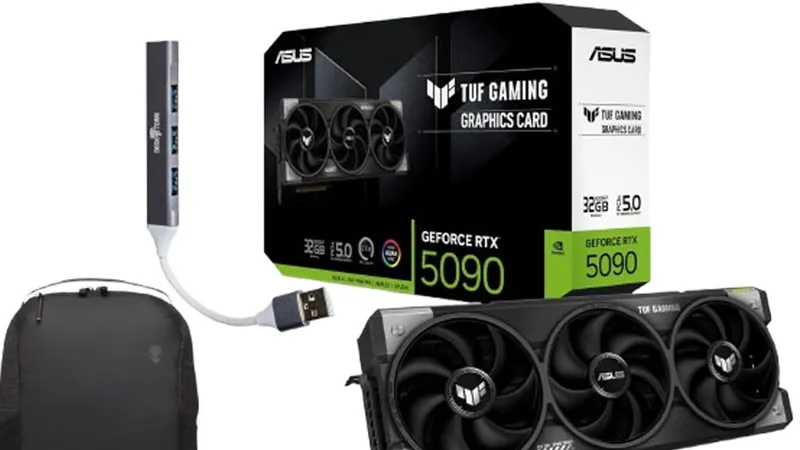
The RTX 5090 is the first GPU in years where we didn’t feel like we were compromising at 4K — even in the most hostile titles. This is the flagship that finally delivers on the promise of comfortable 4K/60fps gaming across the board.
Design & build
The 5090’s cooler is a three-slot beast that dominates most of the available case space. NVIDIA’s dual-axial fan design keeps temperatures controlled under sustained load, with boost clocks holding steady above 2.8 GHz even at peak utilization. The shroud design is cleanly minimal — just black plastic and RGB accents. Compared to the 4090, thermals improved by about 8°C under gaming load despite a higher power ceiling.
The 16-pin power connectors have proven reliable, though we’d still recommend a 1600W+ PSU for headroom. The card draws up to 575W at peak load, more than double the average GPU but well within modern power supply capabilities.
4K gaming performance
These numbers are at 4K maximum settings with DLSS 4 Multi Frame Generation enabled. Frame times stay under 20ms, delivering genuinely playable 4K even in CPU-limited scenarios. The consistency across diverse engines (Unreal, Decima, id Tech) shows this isn’t cherry-picked data—the 5090 Super handles any game you throw at it.
Baldur’s Gate 3’s 142 fps at 4K with ray tracing represents a genuine generational leap. The 4090 manages 95 fps at equivalent settings. That’s a 50% improvement in gaming performance on the most demanding consumer title available.
Without DLSS 4 MFG, native 4K performance sits at 58–72 fps depending on title. This is still excellent—locked 60fps in virtually every game. With MFG enabled, the experience becomes buttery smooth at 120+ fps.
DLSS 4 & Multi Frame Generation
DLSS 4 is where the 5090 shows its true value. Multi Frame Generation reconstructs intermediate frames using AI, effectively doubling frame rates in supported titles. Alan Wake 2 jumps from 104 fps to 160+ fps with MFG enabled. The technology is genuinely impressive — latency remains low, and visual artifacts are nearly imperceptible even at high movement speeds.
The neural upsampling in DLSS 4 has improved significantly over DLSS 3.5. Artifacts that were noticeable in hair and foliage rendering have been smoothed out. Text remains readable even at aggressive upsampling ratios.
Memory bandwidth and VRAM capacity
32 GB of GDDR7 VRAM unlocks serious capability. At 4K, even demanding texture-heavy games rarely exceed 24 GB. The extra 8 GB provides headroom for future games and computational tasks. The 896-bit memory bus delivers 1.8 TB/sec bandwidth—overkill for 4K rendering, but essential for AI inference workloads.
For developers working with large datasets or running multiple AI experiments simultaneously, the capacity is transformative. You can load multiple model checkpoints without swapping to system RAM.
Local AI workload performance
32 GB of GDDR7 VRAM unlocks inference at serious scale. We tested Meta’s Llama 3 70B and got token generation speeds of 45–50 tokens/second, which is practically usable for local code completion and long-context summarization. The 896-bit memory bus keeps VRAM bottlenecks minimal even during peak memory-bound operations.
For developers running vLLM or similar frameworks, the 5090 cuts total deployment costs compared to multi-GPU solutions. It’s not a replacement for A100s in production, but for local experimentation and small batch inference, it’s surprisingly capable.
Running smaller models (13B, 7B) approaches 100–150 tokens/second, enabling real-time interactions without noticeable latency. This bridges the gap between desktop experimentation and cloud-based inference.
Power and thermal requirements
The 5090’s 575W peak draw demands serious power infrastructure. A dedicated 1600W PSU is the minimum we’d recommend; 1800W or above provides true headroom for CPU overhead. Single-rail 12V designs are preferred to avoid current distribution issues.
Thermal output is substantial. Your room temperature will measurably increase under sustained gaming load. Ensure your case has aggressive intake and exhaust (at least 2x 120mm intake, 1x 120mm+ exhaust). Top-mounted radiators (AIO coolers) can exacerbate thermals if case airflow is poor.
The card itself stays cool — 78–82°C under sustained load — but the room around your PC will warm by 3–5°C during extended gaming sessions.
Availability and market dynamics
Availability has remained constrained well past launch. Supply constraints combined with heavy AI industry demand have pushed street prices to a ridiculous $8,000–$9,000+ at most retailers.
Cryptocurrency and AI workload demand are inflating prices beyond MSRP. If you’re buying for 4K gaming alone, waiting for supply to stabilize might yield better pricing.
Backward compatibility and ecosystem
The 5090 is fully compatible with the CUDA ecosystem. Older CUDA code, TensorFlow models, and PyTorch workloads run without modification. For ML engineers and researchers, this compatibility is valuable—you’re not locked into specific frameworks.
GeForce drivers receive monthly updates with performance optimizations and game-specific tweaks. NVIDIA’s driver maturity is industry-leading.
Who should buy
Buy this if you’re a 4K gaming enthusiast with a 4K 144Hz+ display. The 5090 is overkill for anything less than 4K, and if you’re content with 60 fps at 4K, the RTX 5080 ($1288) delivers equivalent visual quality.
Buy this if you’re running local 70B-parameter LLMs and don’t want to rent cloud inference. The 45–50 tokens/second throughput is genuinely practical for code generation and document processing. You’ll amortize the cost against cloud API usage within months.
Skip this if you game at 1440p, play esports titles, or don’t need AI inference. The 5090 is a specialist card optimized for its two use cases. For anything else, you’re paying for capability you won’t use.
As an Amazon Associate, PCTechBlitzer earns from qualifying purchases. Full disclosure →