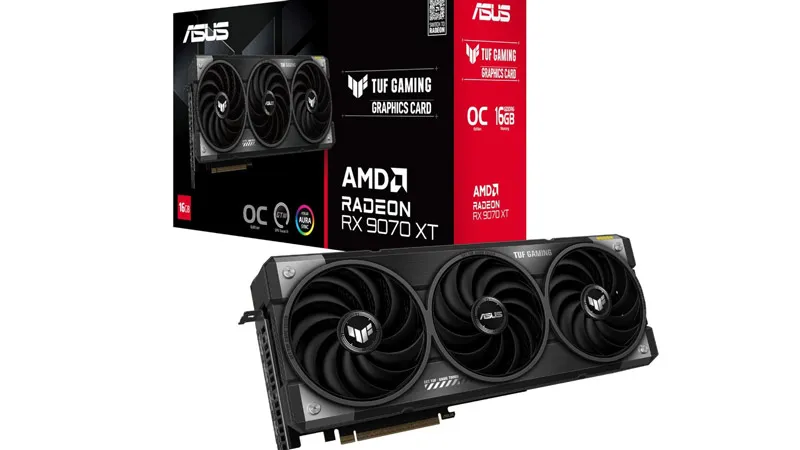
AMD came to play with the RX 9070 XT. For anyone gaming at 1440p on a budget, this is the card. RDNA 4’s rasterization performance is genuinely competitive with NVIDIA’s Blackwell at a lower price point, though ray tracing remains AMD’s weakness.
1440p benchmarks
These numbers represent native 1440p with maximum settings and ray tracing enabled (where applicable). Counter-Strike 2 at 260 fps demonstrates raw rasterization capability—AMD’s RDNA 4 is brutally efficient at standard rendering workloads. Cyberpunk 2077’s 72 fps at 1440p with full ray tracing is respectable, though behind the RTX 5070’s 85 fps at equivalent settings.
The 9070 XT is designed for the 1440p/144Hz sweet spot. At these settings, you’re looking at 60+ fps consistently in demanding titles without resorting to DLSS upsampling.
RDNA 4 architecture overview
The RX 9070 XT features 16,384 stream processors (roughly equivalent to NVIDIA’s CUDA core count) with 576 GB/sec bandwidth. Memory configuration is 16 GB GDDR6 at 288-bit interface—not as fast as GDDR7, but sufficient for 1440p workloads. Clock speeds reach 2.75 GHz boost, matching NVIDIA’s efficiency in terms of FLOPs per watt.
The architecture emphasizes rasterization efficiency at the expense of ray-tracing performance. AMD’s RT unit design is less sophisticated than NVIDIA’s, resulting in lower RT throughput. This is a deliberate trade-off reflecting AMD’s market positioning: rasterization-focused gamers at 1440p.
FSR 4 (FidelityFX Super Resolution 4)
AMD’s answer to DLSS 4 is FSR 4, which includes temporal reconstruction and—in selected titles—frame generation. Visual quality is competitive with DLSS Quality, and AMD claims lower latency than DLSS due to its simpler reconstruction algorithm.
FSR 4 adoption is slower than DLSS 4. Launch support includes Cyberpunk 2077 and Alan Wake 2, with additional titles planned. Unlike DLSS, FSR 4 is open-source, meaning developers can integrate it more freely. However, widespread adoption remains uncertain as of March 2026.
Frame generation (FSR 4 MFG equivalent) is available in select titles, roughly doubling frame rates in supported games. Performance impact is minimal, though some reports of subtle ghosting in fast-motion scenes. Overall, the technology is maturing quickly.
Ray tracing performance
This is where AMD makes compromises. The RX 9070 XT’s ray tracing performance lags NVIDIA by roughly 20–25% in demanding titles. Cyberpunk 2077’s path tracing mode runs at 35–38 fps versus the RTX 5070’s 50+ fps at 4K. For 1440p ray-traced games, the gap narrows but remains visible.
Developers can optimize ray tracing for RDNA 4, which sometimes closes the gap. But first-party optimization is more common on GeForce due to NVIDIA’s market dominance. Expect ray tracing to be marginally slower on AMD for the next 1–2 years.
Rasterization dominance
Outside ray tracing, the 9070 XT is dominant. Counter-Strike 2 at 260 fps shows the card’s raw rasterization horsepower. Most esports titles (Valorant, Overwatch 2, Fortnite) run well above 200 fps at 1440p on the 9070 XT, matching or exceeding NVIDIA’s performance.
For AAA titles without heavy RT, the gap narrows. Hogwarts Legacy at 88 fps competes with the RTX 5070’s 92 fps—within margin of error. Over the broad game library, rasterization performance is competitive.
Thermal and power characteristics
The 9070 XT’s TDP is 265W, which is lower than the RTX 5070’s 290W. In practice, the card draws approximately 280–295W under gaming load, with most partner AIBs staying under 72°C. Fan noise is controlled—typically 65–70 dB at full gaming load.
A 900W PSU is sufficient for a high-end CPU + 9070 XT combo, though 1000W is recommended for headroom. The card’s compact 250mm length and dual-fan design fit most cases without issue.
Driver maturity and software support
This is AMD’s Achilles heel. AMD’s driver team has made significant progress, but GeForce drivers remain more mature. Occasional compatibility issues with newer game titles, infrequent edge-case performance regressions, and delayed optimization patches are known issues. For the most part, drivers are solid, but they trail NVIDIA in consistency.
AMD’s software ecosystem (AMD Adrenalin driver suite) is functional but less polished than GeForce Experience. Performance tuning options exist, but the UI and feature organization aren’t as intuitive.
Memory bandwidth and efficiency
16 GB GDDR6 is adequate for 1440p. Most games use 8–11 GB at 1440p max settings, leaving comfortable headroom. GDDR6’s lower bandwidth (576 GB/sec) versus GDDR7 (1152 GB/sec) could be a bottleneck at 4K, but at 1440p, the architecture’s efficiency compensates.
For content creation (video encoding, rendering), the 16 GB and lower memory bandwidth are less concerning than for gaming. The card handles streaming tasks competently.
Value proposition
At $709, the RX 9070 XT is priced similarly to the RTX 5070 (also elevated above its $599 MSRP). Street prices on both cards have risen since launch due to supply pressure and import tariffs. For pure rasterization gaming at 1440p, this value proposition is undeniable. You’re sacrificing ray-tracing performance and access to cutting-edge upsampling tech (DLSS 4 MFG) in exchange for lower cost.
4K gaming reality
The 9070 XT at 4K is a compromise. Demanding titles like Cyberpunk 2077 at 4K with ray tracing drop to 40–45 fps on the card—playable but not ideal. You’d likely enable FSR 4 upsampling to reach stable 60 fps. The RTX 5070 (and especially 5070 Ti) handle 4K more gracefully.
If you’re targeting 4K performance, step up to the RTX 5070 Ti or consider a higher-end AMD card. The 9070 XT is genuinely a 1440p card.
Final thoughts
The RX 9070 XT is AMD’s strongest competitive position in years. At 1440p, it delivers excellent performance, runs cool, and costs $50 less than equivalent NVIDIA competition. The weaknesses (ray tracing, driver maturity, lack of DLSS 4 MFG adoption) matter less at 1440p than at 4K. For FreeSync monitor owners and AMD system builders, the 9070 XT is a smart choice.
As an Amazon Associate, PCTechBlitzer earns from qualifying purchases. Full disclosure →