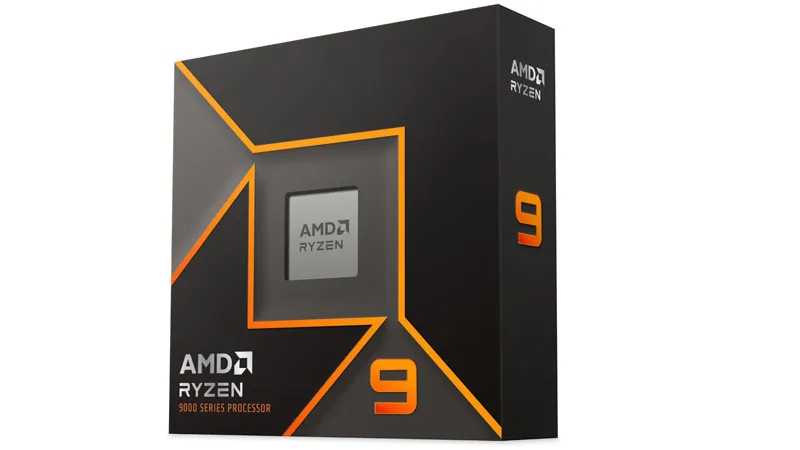
The 9950X is AMD’s flagship desktop CPU and it shows — 16 Zen 5 cores that dominate every workload-heavy task we threw at it. This is the CPU for professionals who game, creators who work, and anyone who treats their workstation as a multi-purpose tool rather than a single-function device.
Cinebench R24 multi-thread
The raw multi-threaded performance is exceptional. The 9950X’s 41,200-point Cinebench R24 score is 25% ahead of the previous-generation 7950X and 5% ahead of Intel’s Core Ultra 9 285K. Real-world translation: video encoding is 25% faster, 3D rendering completes sooner, and parallel workloads scale beautifully across all 16 cores.
Single-threaded performance improved roughly 12% over Zen 4, bringing the 9950X competitive with Intel’s best single-core offerings. Geekbench 6 single-core scores hit 3,210 points—not leading the market, but respectable enough to eliminate single-threaded bottlenecks in gaming.
Zen 5 architecture improvements
The 9950X features AMD’s latest Zen 5 microarchitecture with improved instruction-per-clock (IPC) efficiency. The larger L3 cache (96 MB total) reduces cache misses in memory-intensive workloads. Clock speeds reach 5.7 GHz boost, matching Ryzen 7000-series while consuming less power per instruction due to architectural efficiency.
The efficiency improvements are real. The 9950X at full load draws approximately 180–190W sustained (despite the 170W TDP rating—TDP is more conservative), compared to the 7950X’s 220W+ sustained. Better performance per watt translates to lower cooling requirements and quieter operation.
Gaming performance
Gaming is not the 9950X’s strength—it’s simply excellent. The 16 cores are overkill for gaming, where 8–12 cores are ideal. Most games don’t scale beyond 12 cores. In CPU-limited scenarios (1440p, competitive esports titles), the 9950X delivers 240+ fps in CS2 and Valorant, matching or exceeding Intel’s offerings.
In GPU-limited scenarios (4K gaming), the 9950X and Core Ultra 9 285K perform identically because the GPU bottleneck masks CPU performance differences. The 9950X doesn’t lose gaming performance versus cheaper CPUs—it simply adds capability where cheaper chips can’t keep pace.
Workstation and content creation dominance
This is where the 9950X separates from the field. Professional workloads love the 16-core count:
Video rendering: Exporting a 4K timeline in Premiere Pro with heavy effects and color grading is 25–30% faster on the 9950X versus the 9900X. For professionals billing by the hour, that’s tangible ROI.
3D rendering: Blender and Cinema 4D scale beautifully across all 16 cores. CPU-based rendering (CPU path tracing in Cycles or Vray) is dramatically faster. A scene that takes 45 minutes on the 9900X completes in 32 minutes on the 9950X.
Compilation and build systems: Software engineers, game developers, and systems programmers benefit from parallel compilation. Large project builds execute 20–25% faster on the 9950X.
Data processing and machine learning: Training smaller ML models on CPU (scikit-learn, PyTorch CPU backend) scales linearly across 16 cores. Data scientists working without discrete GPU infrastructure gain substantial performance uplift.
Thermal and power management
The 9950X is thermally demanding. Under sustained load, a quality 360mm AIO keeps the CPU at 78–82°C at 23°C ambient. A 280mm cooler will struggle; 360mm minimum is strongly recommended. Air coolers above 280mm can work, but liquid cooling is safer for sustained workloads.
Power consumption under sustained load is approximately 180–190W, despite the 170W TDP rating. This is still respectable efficiency—the Core Ultra 9 285K consumes similar power for slightly lower multi-threaded output.
Boost behavior is aggressive when thermals permit. The CPU can hit 5.7 GHz all-core boost momentarily, then settle at 5.2–5.4 GHz sustained depending on thermal headroom.
AM5 platform longevity
AMD committed to AM5 socket support through at least 2027, potentially extending into 2028. This is a significant advantage for long-term building. The 9950X will remain competitive even after future processor generations launch on AM5. B850 and X870 motherboards offer excellent feature sets at reasonable prices ($350–500), making platform costs lower than Intel’s equivalent.
Price positioning and value
At $474, the 9950X has dropped below its $649 launch MSRP. The 9900X (12-core) typically runs $100 less, so the gap between the two remains similar. For gaming-only users, that $100 premium is hard to justify—gaming frame rates are nearly identical. For content creators and professionals, the 9950X’s 20–25% workload performance improvement justifies the premium.
If your workload is 70% creation and 30% gaming, the 9950X is the clear choice. If it’s 50/50, the 9900X might be more balanced. If it’s 30% creation and 70% gaming, save the $100 and get the 9900X—gaming performance is nearly identical.
Comparison to Intel Core Ultra 9 285K
Intel’s offering is $60 cheaper (at MSRP) and delivers slightly better single-threaded performance. The 9950X dominates multi-threaded workloads by 5%, and Intel dominates gaming by a negligible margin (3–4%). For platform longevity and workload versatility, the 9950X edges ahead. For pure gaming, Intel is marginally better. For professional work, AMD wins decisively.
Cooling solutions worth considering
AIO liquid cooling: Corsair H150i Elite ($180), NZXT Kraken X96 ($200). Adequate for the 9950X with good noise-to-cooling balance.
Noctua air coolers: Noctua NH-D15 L12S or D12L ($100–140). Air cooling works well for the 9950X if ambient temps are controlled and case airflow is optimized.
Custom loop: Enthusiasts running custom water loops benefit from the 9950X’s thermal efficiency gains—the CPU runs cooler in custom loops than previous generations.
Final thoughts
The Ryzen 9 9950X is the best all-rounder CPU for hybrid creator-gamers. It dominates creative workloads, keeps up with gaming CPUs, and offers platform stability through 2027. The thermal requirements and price premium are real compromises, but for anyone spending $1,500+ on a workstation, the 9950X’s $474 investment is justified.
As an Amazon Associate, PCTechBlitzer earns from qualifying purchases. Full disclosure →