The G7 32 isn’t the most exciting monitor on our bench, but it’s among the most competent at its price point. Samsung’s Odyssey lineup has established itself as the sensible choice for gamers who want value without compromise.
Display technology and specifications
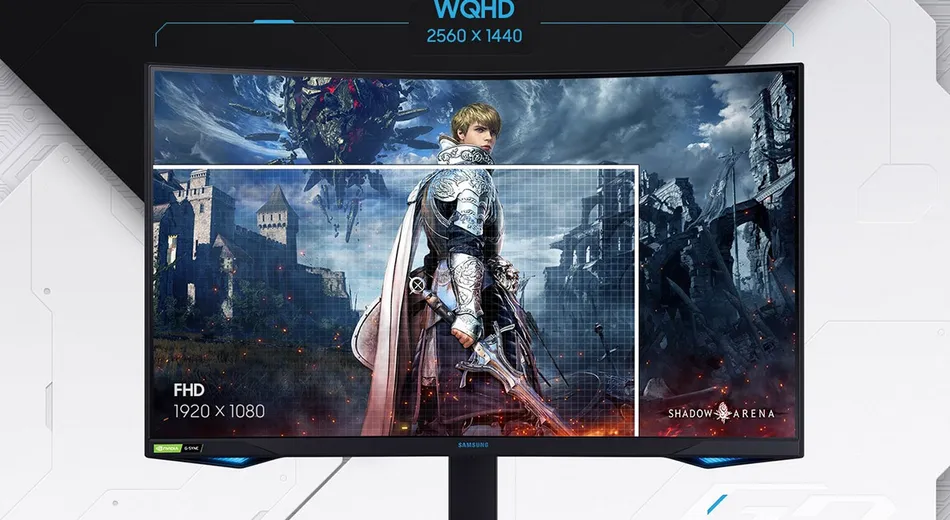
The 32-inch VA panel at 2560×1440 resolution delivers excellent pixel density without requiring RTX 5080-class GPUs to maintain high frame rates. The 1ms response time (gray-to-gray, manufacturer spec) is sufficient for gaming, though real-world measurements show closer to 2–3ms with overdrive enabled.
The 240Hz refresh rate is where this monitor shines. Pairing with an RTX 5070 Ti or RX 9070 XT at 1440p, you’ll hit or exceed 120+ fps in most titles, unlocking the monitor’s full refresh rate. The higher refresh makes motion feel notably smoother compared to 144Hz competitors.
VA panel technology offers inherent advantages: infinite contrast ratio, deep blacks, and excellent off-axis color consistency. The downside is pixel response in dark-to-light transitions (black smear), which manifests in dark scenes with rapid motion—a known VA limitation since the technology’s inception.
Color accuracy and calibration
Samsung pre-calibrates the Odyssey G7 to excellent standards. Out-of-the-box, the monitor ships with ΔE < 2.5 across the sRGB gamut. This is respectable for a gaming monitor and acceptable for non-color-critical creative work. If you’re doing color-grading or photo editing, a hardware calibrator would improve consistency, but standard gamers won’t need calibration.
Peak brightness reaches 350 nits in SDR mode and approximately 500 nits in HDR peak mode. The HDR peak brightness lags behind OLED monitors (1000+ nits) and newer Mini-LED panels (600+ nits), limiting HDR impact. HDR content is usable but not transformative—the technology is present more for feature compliance than genuine visual impact.
Response time and motion clarity
The advertised 1ms response time is achievable with overdrive enabled, though standard overdrive settings produce imperceptible ghosting. At 240Hz, motion clarity is excellent. Side-by-side with 165Hz or 144Hz monitors, the jump to 240Hz is visually apparent in fast-panning scenes and competitive gaming scenarios.
Gaming at 240Hz on this monitor feels responsive and clean. Esports players will appreciate the refresh rate, though the responsive feel is contingent on your GPU maintaining 144+ fps in your chosen games.
Black smear and VA limitations
VA panels exhibit “black smear”—ghosting in dark-to-dark transitions or when transitioning from bright areas to dark areas. In Demon’s Souls Remake’s dark environments, fast camera pans reveal noticeable trails behind character shadows. This is inherent to VA technology and not specific to this monitor—all VA panels exhibit some degree of smear.
For most gaming (outdoor scenes, well-lit environments), black smear is invisible. For horror games and dark action titles, it’s noticeable but not game-breaking. If you’re sensitive to motion artifacts, an IPS or OLED alternative would be better, though at higher price points.
Build quality and stand
The monitor chassis is robust aluminum and plastic construction. The stand offers height adjustment (limited to approximately 130mm), tilt, and swivel. Pivot (90-degree rotation) is not supported. For users wanting portrait mode or extreme stand flexibility, the G7 is restrictive.
VESA 100mm mounting is supported, allowing full-arm monitor stands. Cable management is adequate with clips on the back and under-monitor routing. The power supply is external (universal brick), reducing heat and cable clutter.
Connectivity
Standard connectivity includes DisplayPort 1.4, HDMI 2.1, USB-C with 90W power delivery, and 3.5mm audio jack. The USB hub offers three downstream ports (5 Gbps), useful for peripherals. USB-C charging (90W) is sufficient for laptops up to 13–14 inches under gaming load.
Firmware updates are periodically rolled out, addressing minor tweaks and compatibility. Samsung’s update cadence is reasonable, though less frequent than some competitors.
Gaming and use cases
Pair this with an RX 9070 XT or RTX 5070 and you have a well-matched 1440p gaming setup that exceeds 100 fps in most demanding titles. At 1440p, visual fidelity remains sharp while GPU overhead is manageable. This is the sweet spot for mid-range to enthusiast gaming rigs ($2,500–4,000 total cost).
For esports (CS2, Valorant), the monitor is overkill in raw capability—those games easily exceed 240 fps even on mid-range GPUs. The 240Hz panel ensures you’re not bottlenecked by display refresh rate. The minimal input lag and clean motion handling give competitive players confidence.
Contrast and dark performance
The VA panel’s infinite contrast ratio (true blacks produce zero backlight bleed) excels in dark gaming environments. Compared to IPS panels (15,000:1 contrast), the Odyssey G7 makes shadowed areas dramatically more convincing. This is a meaningful advantage for atmospheric gaming titles.
Peak brightness in SDR (350 nits) is sufficient for bright indoor environments but not outdoor sunlight-proof. The monitor handles typical office and gaming room lighting well.
Price and positioning
At $449, the Odyssey G7 32” is competitively priced. IPS alternatives at similar specs cost $550–650 (better off-axis viewing, no black smear, but lower contrast). OLED alternatives are significantly more expensive ($800+). For the balance of performance, build quality, and price, the G7 is hard to beat.
For budget-conscious gamers, the 27-inch Odyssey G7 (1440p 240Hz) costs $350–400 and delivers similar specs in a smaller package. The 32-inch version is for those who want the screen real estate.
Final thoughts
The Odyssey G7 32” is the reliable option for gamers who want a 1440p/240Hz panel without premium pricing. It’s not the prettiest monitor, it’s not the most feature-rich, but it’s genuinely competent. Build quality holds up across multiple years, color accuracy is acceptable, and motion handling is excellent. For mainstream gamers, this is the monitor to recommend.
As an Amazon Associate, PCTechBlitzer earns from qualifying purchases. Full disclosure →