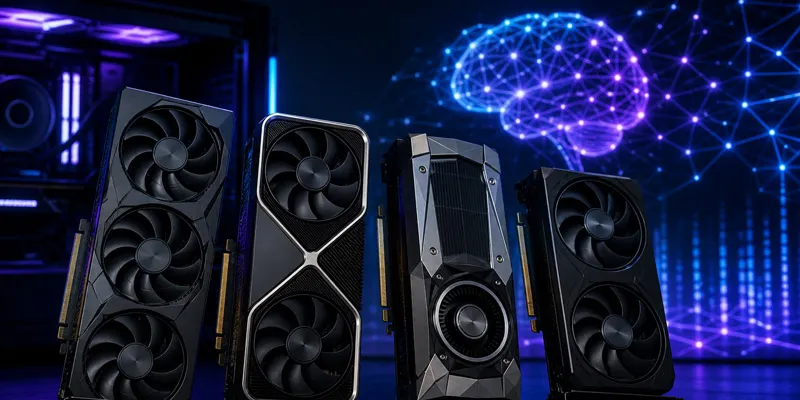
Best GPUs for Local AI in 2026: Every Budget Covered
In 2026, 16GB of VRAM is the new floor for a comfortable local AI experience. Multi-modal models that combine vision, audio, and text are pushing memory requirements up, and the era of scraping by on 8GB is officially over. The good news? The market has never had better options across every price tier — from a $249 entry-level pick that crushes NVIDIA’s equivalent to a $949 card that holds 27B models with room to breathe.
Here’s what to buy right now, organized by budget.
Best Overall — NVIDIA GeForce RTX 5090 (~$2,000)
If budget isn’t the constraint, the RTX 5090 is the no-compromise answer for local AI in 2026. 32GB of GDDR7 at 1,792 GB/s memory bandwidth — that’s nearly 3x the bandwidth of the previous generation — means token throughput for 7B and 13B models is in a different league. The CUDA ecosystem is still the most mature for inference: vLLM, llama.cpp, Unsloth, and every major framework just works.
At Q4 quantization, the 5090 runs 70B models on a single card. That’s a milestone that previously required $8,000+ in data center hardware. For Stable Diffusion, video generation, and multi-modal workflows, the 1,792 GB/s bandwidth is even more impactful than raw VRAM capacity.
The catch: MSRP is $1,999, but AIB cards are currently selling for $2,500–$3,500 at retail. Patience is a virtue here.
Check RTX 5090 Price on Amazon →Best VRAM Per Dollar — Intel Arc Pro B70 ($949)
The most interesting GPU story of the year. The Arc Pro B70 ships with 32GB of GDDR6 for $949 — the same VRAM as the RTX 5090 at less than half the price. In benchmarks on Ministral 8B, it puts up 85% higher token throughput than NVIDIA’s RTX PRO 4000 at roughly half the cost.
The sweet spot: Qwen 3.5 27B at 4-bit quantization fits on a single B70 with context headroom to spare. That’s a genuinely powerful model running locally on a sub-$1,000 card. OpenVINO is the recommended inference path and it’s solid — CUDA it isn’t, but PyTorch XPU support landed officially in 2025 and the ecosystem is moving fast.
We’ve got a full review of the Arc Pro B70 if you want the deep dive.
Check Arc Pro B70 Price on Amazon →Best Mid-Range — AMD Radeon RX 7900 XTX (~$800)
The RX 7900 XTX is the best 24GB option under $1,000, and 24GB is enough to run 30B models at Q4 without CPU offload. ROCm has matured significantly — llama.cpp and Ollama both run well on AMD hardware now, and PyTorch ROCm support is stable.
It won’t hit the throughput of the Arc Pro B70’s XMX engines, but if you’re already in the AMD ecosystem or want a dual-purpose gaming/AI card, the 7900 XTX is a genuinely excellent pick. Performance in rasterization games is strong, and the 24GB VRAM gives you headroom for image and video generation workloads too.
Check RX 7900 XTX Price on Amazon →Best Budget — Intel Arc B580 ($309)
At $309 with 12GB of GDDR6, the Arc B580 is a genuine revelation for the budget tier. It benchmarks at around 62 tok/s on 8B models — faster than any NVIDIA card at this price point. For users who primarily want to run 7B and 8B models locally (which covers most popular models: Llama 3.1 8B, Mistral 7B, Gemma 7B), the B580 delivers a completely fluid experience.
You won’t run 13B models at full precision, but 4-bit quantization on 13B fits in 8–9GB, leaving some headroom. The XMX engines punch above their weight at INT4/INT8 inference. If you’re just getting started with local AI and don’t want to drop $1,000 on your first GPU, this is the one to buy.
Check Arc B580 Price on Amazon →How to Choose
Prioritize VRAM over GPU generation. A 3-year-old card with 24GB will outrun a brand-new card with 8GB for local LLM work. Memory capacity is the primary bottleneck — once a model fits in VRAM, throughput differences between GPU generations are secondary.
Know your target models. If you mostly run 7B–8B models: 12–16GB is fine, save money with the B580. For 13B models at full quality: 24GB is comfortable. For 27B+ or multi-modal workflows: go 32GB.
CUDA vs. alternatives. CUDA is still the most friction-free ecosystem, but Intel’s OpenVINO and AMD’s ROCm have closed the gap significantly in 2025–2026. If you’re using Ollama or llama.cpp, all three platforms work well. Custom CUDA kernels or niche frameworks may require more setup time on non-NVIDIA hardware.
Bottom Line
For most local AI users in 2026, the Intel Arc Pro B70 at $949 is the best value proposition on the market — 32GB VRAM and strong inference performance at a price that doesn’t require a second mortgage. If you want the full CUDA ecosystem and the fastest throughput available, save up for the RTX 5090. And if you’re just starting out, the Arc B580 at $309 is a fantastic entry point that won’t leave you frustrated.